Product links on this page go to Amazon. If you buy through them, Your First Paddle earns a commission. How we pick and earn
Two balls that look alike, and the wrong one ruins a game. Here’s the difference, the rules behind it, and which to buy.
What the rules say
USA Pickleball’s equipment standards define the ball: 2.87 to 2.97 inches in diameter, 0.78 to 0.935 ounces, a bounce of 30 to 34 inches from a 78-inch drop onto granite, and between 26 and 40 circular holes. Any ball used in a sanctioned tournament must be on the approved list. Within those limits, indoor and outdoor balls sit at opposite ends.
Outdoor balls
An outdoor ball is harder plastic, a little heavier, with 40 small holes. The weight and the small holes keep it from being pushed around by wind, and the hard plastic makes it fast off the paddle and loud. The cost is durability: outdoor balls crack, sooner in cold weather and after a few weeks of hard play, and a cracked ball bounces wrong. Players carry a sleeve and expect to retire balls.
The Franklin X-40 is the standard: most tournaments and most open-play sessions use it. The Dura Fast 40 is the original, harder and faster. The ONIX Fuse G2 is weighted for wind and lasts longest.
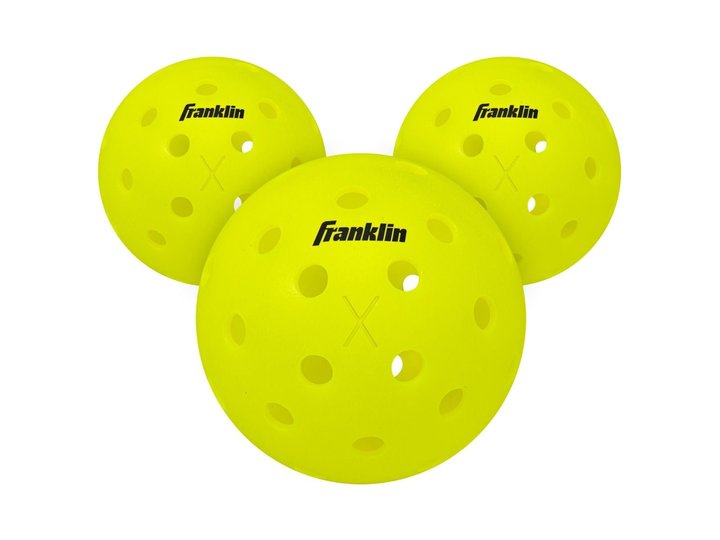
Outdoor ball, the tournament standard
Franklin X-40 outdoor balls
Franklin X-40 Outdoor
The ball most tournaments and most open-play sessions use: 40 machine-drilled holes, on USA Pickleball's approved list, sold in packs from 3 to 100.
- Use
- Outdoor
- Holes
- 40
- Colors
- Optic yellow, plus lava, ember, purple, blue, green
- Packs
- 3, 6, 12, 36, 100
- USA Pickleball
- Approved
Suits: Anyone playing outdoors. If you buy one kind of ball, buy this one.
Weigh: Like every hard outdoor ball it cracks in cold weather and after a few weeks of hard play. Franklin's own page is unreachable, so the hole count is from its listing.
Indoor balls
An indoor ball is softer plastic with 26 larger holes. On a gym floor a hard ball skids and bounces high; the softer ball bites the wood and stays low. It’s slower, quieter and lasts far longer, because it bends instead of cracking. Outdoors it’s a disappointment: the wind moves it and it dies off the paddle.
The Franklin X-26 is the indoor version of the X-40. Many rec centers supply their own; ask.
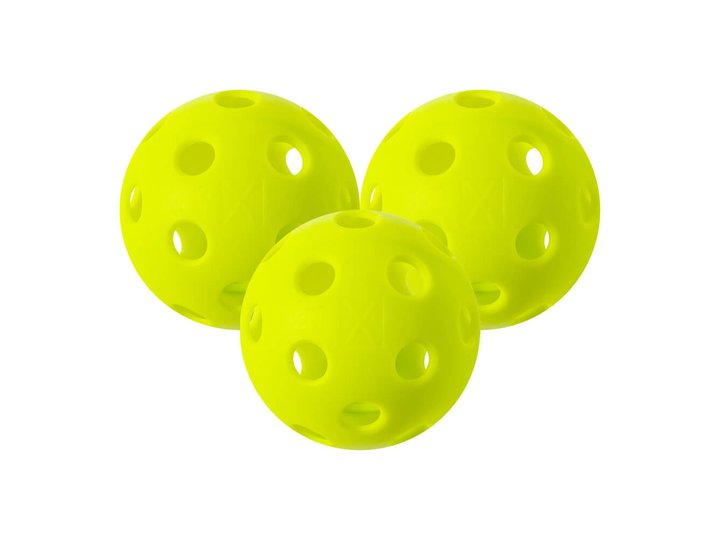
Indoor ball
Franklin X-26 indoor balls
Franklin X-26 Indoor
The indoor version of the X-40: 26 larger holes and a softer plastic, made for gym floors where an outdoor ball skids and bounces too high.
- Use
- Indoor
- Holes
- 26
- Colors
- Optic yellow, orange
- Packs
- 3, 6, 12, 100
- USA Pickleball
- Approved
Suits: Rec-center and gym sessions. Ask what ball the session uses; indoor is usual.
Weigh: Too soft and slow for outdoor play. An indoor ball on an outdoor court is the most common wrong purchase.
Which to buy
- Outdoor courts: outdoor balls. A 12-pack lasts a casual player a season.
- Gym or rec center: indoor balls, or whatever the session supplies.
- Both: a few of each in the bag.
- Kids and first-timers, anywhere: an indoor ball is softer and slower, which makes rallies longer. It’s a fine ball to learn with on an outdoor court on a calm day.
Color
Pick the color you can see against your court and its background. Yellow is standard. Neon green on a green court, or yellow in a gym with yellow walls, is the common mistake; orange indoor balls exist for that reason.
Why balls crack, and when to retire one
Plastic gets brittle in the cold, so an outdoor ball in a 45-degree morning cracks on the first hard volley. Heat softens it and makes it go “out of round”, with a wobbly bounce. Keep balls out of the car in both seasons. Retire a ball when it has a visible crack, when it bounces lower than its sleeve-mates from the same height, or when it rattles.
More on bags, grips and nets on the gear page.